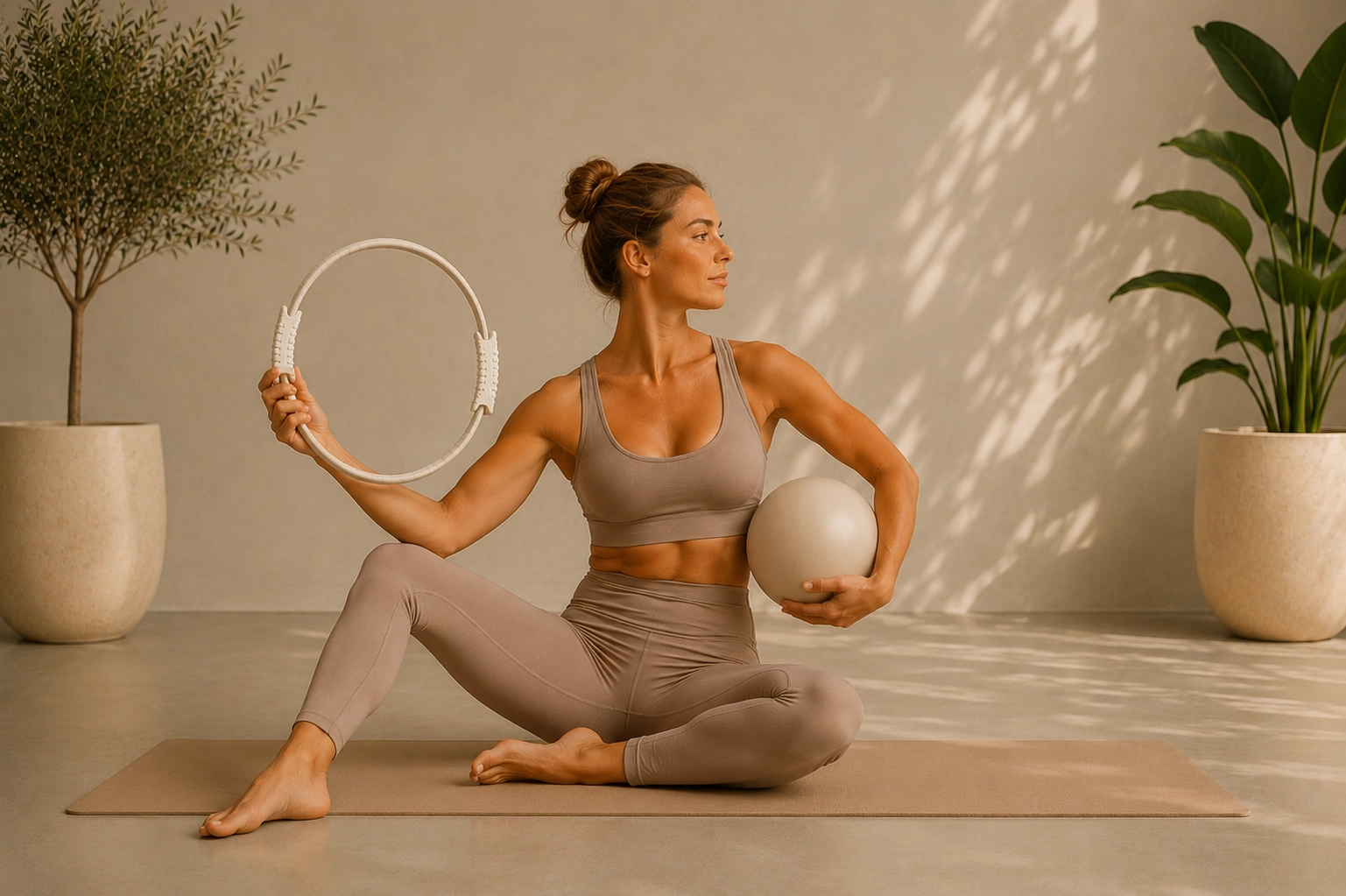
The pilates ring and the pilates ball are the two best-known small props in pilates. Both are light, fit in any cupboard and promise the same thing: a stronger core and more control. Yet they work differently. The ring adds resistance: you work against the rebound of the ring. The ball demands stability: it gives slightly, so your stabilising muscles have to become more active to keep your pelvis and spine in the right position. In this article we explain what that difference means in practice, which exercises belong to which prop and when it is best to combine them.
The difference in one sentence
With a pilates ring you push (or squeeze) against something that springs back, so your muscles have to do extra work. With a pilates ball you place something under or between your body that gives slightly, so your deep stabilising muscles have to work to keep your alignment. The ring makes an exercise harder, the ball makes an exercise more precise.
What does the pilates ring actually do?
A pilates ring (the Fitness Circle in STOTT Pilates, also known as a magic circle) is a flexible ring of about 35 cm with a fibreglass core and two grip pads. As soon as you press it, it springs back. That rebound is the resistance you work against. Because the resistance comes from two sides, you activate muscles you normally barely feel: the adductors on the inside of your thighs, the inside of your arms and the transverse abdominis that stabilises your pelvis.
Where the ring is strongest
The ring shines in exercises where you squeeze or push something away. Think of the Shoulder Bridge with the ring between your knees, the Hundred with the ring between your ankles, the Side Leg Lift Series with the ring between your ankles, or a Chest Press with the ring between your hands. The resistance is light but constant, so your muscles stay under tension for a long time. That is exactly the type of stimulus pilates is known for: no explosive power, but endurance and control. Ready-made sequences are in our pilates ring workouts.
What does the pilates ball actually do?
The pilates ball (the Mini Stability Ball in STOTT Pilates) is a soft, lightly inflated ball of about 20 cm. You never inflate it hard; the slight give is precisely what makes it valuable. Place it under your pelvis (sacrum) during a Leg Circle or Hip Lift and your pelvis no longer rests stably on the mat, so your abdominals and pelvic stabilisers have to take over. Squeeze it between your knees during an Ab Prep or Shoulder Bridge and you automatically keep your legs aligned and feel immediately whether your pelvis stays neutral. The ball gives feedback: if you lose the pressure on the ball or your pelvis tilts, you feel it straight away.
Where the ball is strongest
The ball is ideal for exercises around posture, balance and learning to feel your deep abdominals. The Ab Prep with the ball between your knees, the Shoulder Bridge with the ball under your sacrum, the Single Leg Stretch with the ball between your hands, or the Side Leg Lift Series with the ball between your ankles: these are exercises where precision, not weight, is the challenge. The ball is also lovely for mobility and recovery, for example rolling your upper back over it (thoracic extension) after a day of sitting. Full sequences are in our pilates ball workouts.
Ring or ball: choose based on your goal
Do you mainly want to get stronger, feel more muscle tension in your legs, arms and core and make your workout harder without weights? Then the pilates ring is your first choice. Do you mainly want to move better, improve your posture, learn where your deep abdominals are or build up gently after a workout or injury? Then start with the pilates ball.
If your lower back bothers you during ab exercises, the ball is often the better start: it helps you keep your pelvis neutral and forces you to work from your abs rather than your back. If you feel pilates without props is getting too easy, the ring adds that extra layer of resistance you are looking for.
Why they work best together
Most people who practise pilates for a while end up with both. Not because they have to, but because the two complement each other within one session. A logical structure for a twenty-minute session is: warm up with the pilates ball (Imprint & Release with the ball under your sacrum, Cat Stretch with the ball between your hands), then do the strength section with the pilates ring (Shoulder Bridge, inner thigh squeeze, Chest Press) and finish with the ball for balance and mobility (Side Leg Lift with ball, thoracic roll over the ball). That way you train strength and control in one session, which is exactly the combination that makes pilates so effective.
Practical tips
Pilates ring
Never squeeze at full force. A pilates ring is meant for constant pressure of around 40 to 60 percent, so you can do twenty to thirty repetitions with control. Keep your shoulders low when using the ring with your arms and exhale as you squeeze.
Pilates ball
Do not inflate the pilates ball fully. It should give about two to three centimetres when you press on it. The softer the ball, the more feedback you get and the more comfortable it is under your pelvis. Start with the ball between your knees in exercises where you lie on your back; that is the safest way to learn to use it.
Frequently Asked Questions
Can I replace a pilates ring with a pilates ball?
Not really. The ring adds resistance, the ball demands stability. You can squeeze the ball between your knees during a Shoulder Bridge, but you miss the rebound that puts your inner thighs to work.
Which is better for beginners?
The pilates ball is usually more accessible because it helps you feel where your abs are and keeps your pelvis neutral. The ring is also suitable for beginners, but requires slightly more awareness of your posture.
Which is better for abs?
Both, in different ways. The ball teaches you to engage your deep abs (stability), the ring makes exercises like the Hundred and Obliques harder (strength). For visible results, combine them.
What size should they be?
A pilates ring is standard 35 to 38 cm, which suits every height. A pilates ball is 20 to 25 cm; smaller gives more feedback, larger gives more support.
.webp&w=384&q=75)



.webp&w=256&q=75)